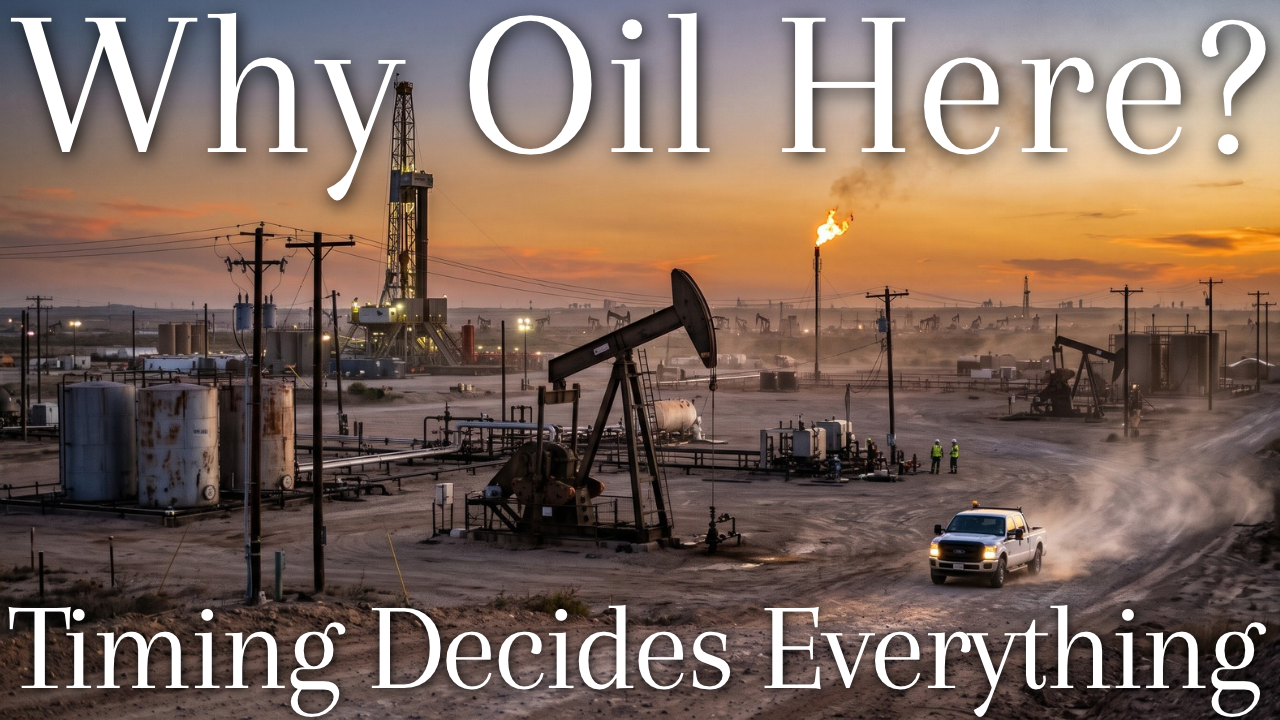
A photograph of an oil field often gives the tallest machine all the attention. If you came looking for what an oil field actually is, start with a question the photograph leaves open. What would still be there if every vehicle and piece of equipment were taken away?
Follow the path from source rock to reservoir, then use the second half to test common assumptions about what an oil field looks like underground.
Inside the Oil Field
Kindle edition on Amazon
Financial Bundle — books on energy and the economy
Oil Field vs. Oil Rig
Chapter 1: What an Oil Field Is, and What It Is Not
A definition that starts underground
An oil field is an area of the Earth’s surface beneath which one or more underground accumulations of petroleum are trapped and can be produced through wells. The core idea is the accumulation, not the equipment. Petroleum geologists usually call each separate accumulation a reservoir or a pool: a body of porous, permeable rock whose tiny pore spaces hold oil, gas and water, sealed above by rock that the fluids cannot easily pass through. When several such reservoirs are stacked or clustered under the same structural feature, the whole group is mapped and managed as a single field.
The surface outline of a field is therefore a projection. Draw the edges of the trapped oil on a map, extend those lines upward, and the area enclosed on the ground is the field. That is why fields have names tied to places, such as Ghawar, Burgan, Daqing or Spindletop, and why their boundaries can grow when new wells find oil beyond the expected edge or shrink when a promising flank turns out to hold only water.
Several neighbouring terms are often mixed up with field, and the differences matter in everything from job listings to news reports:
- A reservoir is the rock unit that actually holds the oil, such as a sandstone or a fractured limestone.
- A field is the collection of reservoirs under one trap or closely related traps, with its own name and production records.
- A play is a group of fields or prospects that share the same geological recipe, so that success in one suggests success in others nearby.
- A basin is the much larger depression in the Earth’s crust in which sediments accumulated over millions of years, and which may contain hundreds of fields and several plays.
- A lease is a legal unit, the tract of land or seabed over which a company holds the right to drill and produce.
Size shows how far apart these levels can be. Saudi Arabia’s Ghawar, the largest conventional oil field known, covers about 3,300 square miles. The Permian Basin of West Texas and southeastern New Mexico, which is not one field but a basin containing many, covers roughly 86,000 square miles. A news story that says the Permian is the world’s most productive oil field is using the word loosely; a geologist would say basin.
The word in Japanese, Chinese and English
The Japanese term 油田 is written with two characters: 油, meaning oil, and 田, the character for a cultivated field, the same one used for rice paddies. Read together as yuden, it carries exactly the sense of the English oil field: land that yields oil the way a paddy yields rice. For readers searching for the oil field kanji, those two characters are the whole answer, and the metaphor inside them is easy to remember. A gas field is ガス田, gasuden, built on the same pattern.
Chinese uses the identical characters, pronounced yóutián in Mandarin. China’s national oil companies name their operating units after the fields they run, so Daqing Oilfield and Jilin Oilfield are at once places and corporate subsidiaries. In both Japanese and Chinese the word has also acquired a figurative meaning similar to the English gold mine. A Japanese business writer might call a profitable product line a company’s 油田, and a sentence such as この地域では新しい油田が発見された, a new oil field was discovered in this region, is a typical textbook example of the literal use.
In English, oil field is written as two words or as the single compound oilfield, and both are correct. British and industry writers favour oilfield, especially as an adjective in phrases such as oilfield services. American newspapers more often write oil field. Neither spelling changes the meaning.
Oil field versus oil rig
The most common confusion is between the field and the rig. An oil rig is a machine, or a structure carrying machines, that drills wells. A field is a place and a geological object. One field may host dozens of rigs over its life, or none at all for years once drilling is finished. Most of the time, a mature onshore field has no drilling rig on it at all. What a visitor sees instead are completed wells, each topped by a wellhead and an assembly of valves, many of them fitted with pumpjacks that lift oil from below, plus flowlines, separators, storage tanks and compressors.
Offshore usage blurs the distinction further, because the word rig is used colloquially for production platforms as well as for mobile drilling units. A drilling rig offshore may be a jackup that stands on legs on the seabed, a semisubmersible floating on pontoons, or a drillship. A production platform, by contrast, is a permanent installation that gathers oil from wells and sends it ashore by pipeline or tanker. When a newspaper reports an accident on an offshore rig, the reader has to check which kind it was. The distinction also matters for job seekers. An advertisement for rig work usually means joining a drilling crew that moves from well to well, while field work often means maintaining production equipment at wells that are already flowing.
The table below sets out the contrast.
| Feature | Oil field | Oil rig |
|---|---|---|
| What it is | A trapped accumulation of petroleum and the surface area above it | A machine or structure that drills or services wells |
| Lifespan | Decades, sometimes more than a century | Weeks to months at any single well, then moved |
| Typical crew | Pumpers, operators, roustabouts, maintenance trades | Driller, derrick operator, floorhands, motorhand |
| Owned by | Operator and partners holding the lease | Usually a drilling contractor hired by the operator |
Explaining an oil field to a child
Parents and teachers often look for a simple way to describe an oil field to children. One version that respects the science goes like this. A very long time ago, tiny plants and animals lived in seas and lakes. When they died, some sank into mud on the bottom. Over millions of years more mud piled on top and pressed down, and the Earth’s heat slowly cooked the buried remains into oil and gas. Oil is lighter than water, so it crept upward through tiny holes in the rocks, like water rising in a sponge, until it bumped into a layer of rock it could not get through. There it collected, filling the holes in the rock beneath that lid. People drill a hole down to that rock and the oil comes up the pipe. The place on the surface above all that trapped oil is the oil field.
The analogy that most often helps is a sponge under a plate. The oil is not a lake in a cave. It is spread through the pores of solid rock, the way water is spread through a sponge, and the plate is the sealing rock that keeps it from escaping. That single picture prevents the commonest misunderstanding adults carry into later life, the idea that drilling taps an underground pool that can be emptied like a bathtub.
What photographs of oil fields actually show
Search for images of oil fields and the same handful of objects appear again and again. Recognizing them turns a generic photograph into something readable.
The pumpjack, sometimes called a nodding donkey or horsehead pump, is the iconic image. Its beam rocks up and down, driving a string of steel rods that works a pump far down the well. Pumpjacks are a sign of a field old enough or low enough in pressure that oil no longer flows to the surface by itself. Fields with strong natural pressure, or wells fitted with submersible electric pumps or gas lift, have no pumpjacks at all, only compact wellheads.
Tank batteries are clusters of cylindrical tanks where oil, water and gas from several wells are separated and stored before oil is trucked or piped away. A line of tall slender towers with flames at the top marks flare stacks, used to burn gas that cannot be sold or must be released for safety. Wide square gravel pads with a tall mast mean a drilling rig is at work. In photographs taken from the air over West Texas or North Dakota, the pads form a grid with long straight roads between them, because modern horizontal wells are drilled in regular patterns from shared pads.
Offshore photographs show platforms on steel legs or floating production vessels moored to the seabed. Night images often show the flare as the brightest point for miles. Historical photographs, especially from Spindletop in Texas or Baku in Azerbaijan, show forests of wooden derricks standing almost touching each other, the result of many owners drilling small tracts as fast as they could. That crowding wasted reservoir pressure and is one reason modern regulators control well spacing.
Who works in a field once it is producing
A producing field is a workplace with its own routine, and the job titles reflect it. Pumpers, formally called wellhead pumpers, drive a daily route from well to well, reading gauges, checking for leaks, adjusting chokes and recording volumes. United States labour statistics show that wellhead pumpers are the single largest occupation in the oil and gas extraction industry, with about 12,190 jobs in May 2025. That fact alone says something about what an oil field is: less a site of dramatic drilling than a long-lived system of wells that has to be watched, maintained and repaired every day for decades.
A field is born when a trap fills, discovered when a well finds it, developed with rigs and pipe, produced for years by pumpers and operators, and finally plugged and abandoned when the oil left is no longer worth lifting. The next chapter goes back to the beginning of that story, to explain why oil ends up trapped where it does.
How Oil Fields Form Underground
Picture a museum displaying a drilling rig beside a rock sample small enough to hold in your hand. You could walk around the rig and still need a magnifying glass to see the spaces between the grains in the sample. The next section starts at that smaller scale and follows the history of the rock.
Chapter 2: How Oil Fields Form
Four conditions that must line up
Petroleum geologists describe the birth of an oil field with a concept called the petroleum system. The phrase sounds abstract, but the idea is concrete: an oil field exists only where a sequence of geological events happened in the right order and in the right place. There has to be a source rock rich in organic matter. That rock has to be buried deeply enough, for long enough, to be heated until the organic matter turns into oil and gas. The fluids must then migrate out of the source rock into a porous reservoir. Finally, the reservoir must sit inside a trap, capped by a seal, that formed before the oil arrived and survived afterward. If any one link is missing, the oil either never forms, never collects, or leaks away to the surface and is lost.
The classic statement of this framework appears in a volume edited by Leslie Magoon and Wallace Dow for the American Association of Petroleum Geologists in 1994, and it remains the standard way to think about exploration. It explains a basic fact that surprises many people: most of the sedimentary rock on Earth holds no commercial oil at all, even where organic-rich layers exist. Timing failures are as common as missing ingredients. A trap that formed after the oil had already migrated past it will be empty, however perfect its shape.
Source rock and kerogen
The story starts in water. In quiet seas, lagoons and deep lakes, microscopic algae and plankton bloom, die and sink. Where the bottom water is low in oxygen, their remains are not eaten or oxidized before burial. They accumulate in fine mud, which later hardens into dark shale or marl. Over time the soft organic material is transformed into kerogen, a waxy, insoluble substance scattered through the rock. Kerogen is the raw material of petroleum.
Not all kerogen is equal. Geochemists classify it into types according to its origin and chemistry. Kerogen derived mostly from marine algae and plankton is rich in hydrogen and tends to generate oil. Kerogen derived from land plants, such as woody debris washed into deltas, is poorer in hydrogen and tends to generate gas, and coal is its extreme form. The type of kerogen in a basin’s source rock therefore goes a long way toward deciding whether that basin becomes oil country or gas country.
The oil window
Buried kerogen does nothing useful at shallow depth. It has to be cooked. As sediments pile up, the source rock sinks and warms, because temperature in the crust rises with depth. Once the rock reaches a certain temperature, the long organic molecules in kerogen start to break into shorter ones, the liquid and gaseous hydrocarbons that make up petroleum. The temperature range in which this cracking yields mainly liquid oil is called the oil window.
Textbooks commonly give the oil window as roughly 60 to 120 degrees Celsius, corresponding in many basins to depths of about two to four kilometres. That range is an approximation, and published figures differ. Some university course materials place the start of oil generation near 60 degrees and its end as high as 150 degrees, and note that the exact numbers depend on the type of kerogen and on how long the rock spent at temperature. Heating a source rock gently for a hundred million years can produce the same result as heating it more strongly for a shorter time. Below the oil window, at higher temperatures, the remaining kerogen and any oil left behind are cracked further into natural gas, which is why the deepest parts of many basins produce gas rather than oil.
This simple thermal ladder explains why oil fields cluster at intermediate depths in a basin and why explorers spend so much effort reconstructing a basin’s burial history. If a source rock never got deep enough, it is immature and has generated little. If it went too deep, it is overmature and has given up its oil long ago. The sweet spot lies in between.
Migration: how oil leaves home
Oil and gas are less dense than the salty water that fills the pores of buried rock. As petroleum forms inside a source rock, rising pressure from generation and compaction squeezes it out, and buoyancy pushes it upward and sideways through any connected pathways it can find: permeable layers, fractures, faults. This movement is called migration. Primary migration is the escape from the source rock itself, which is tight and fine grained; secondary migration is the longer journey through carrier beds toward a trap.
Migration can cover tens of kilometres laterally. That distance explains why a field can lie far from the deep kitchen where its oil was generated, and why a geologist looking at a map of fields will often trace them back to a single source rock in a deeper part of the basin. Along the way, much of the oil is lost, smeared through carrier beds as residual droplets or leaked to the surface where it forms seeps. Natural oil seeps, which have been known since antiquity in places from Mesopotamia to Japan’s Niigata coast, are proof that a petroleum system is working somewhere below, even if the trap that would have held the oil is missing.
Reservoir rock: where the oil lives
A reservoir has to do two things. It must have porosity, meaning enough open space between grains or within fractures to hold fluid, and it must have permeability, meaning those spaces must connect well enough for fluid to flow toward a well. Sandstones and limestones are the commonest reservoir rocks. A clean, well-sorted sandstone deposited in a river channel or on a beach can have porosity of twenty to thirty percent. Some carbonate reservoirs are even better. The Arab-D limestone that forms the main reservoir of Ghawar in Saudi Arabia has porosity of up to 35 percent, according to an analysis in the Journal of Petroleum Technology, an extraordinary figure that helps explain why that field has been so prolific.
Porosity alone is not enough. A pumice stone is full of holes, but the holes are sealed from one another. Chalk can be highly porous yet poorly permeable unless it is fractured. The North Sea’s Ekofisk field in Norwegian waters is a famous chalk reservoir that produces because natural fractures connect its pores. Shale, by contrast, has very low permeability, which is why oil generated in shale tends to stay there unless engineers create artificial fractures.
The fluids in a reservoir are rarely only oil. Pores also hold water, usually salty, and often a cap of free gas above the oil. The proportions change as a field ages. In old conventional fields of the Permian Basin, a study by Bridget Scanlon and colleagues at the University of Texas found that wells produce about thirteen barrels of water for every barrel of oil. That ratio, published in 2017, is a reminder that an oil reservoir is really a water reservoir with oil in it, and that the work of a field is as much about moving water as about moving oil.
Traps and seals
A trap is any arrangement of rock that stops migrating oil and holds it in place. Geologists divide traps into a few families.
- Structural traps are created by deformation of the rock. The simplest is an anticline, an upward fold shaped like an upturned bowl, with oil collecting at the crest. Ghawar is a giant example of a simple anticline. Faults can also form traps when they move a reservoir rock against an impermeable layer.
- Salt-related traps form where buried salt, which is weak and buoyant, flows upward into domes and walls, bending surrounding layers and creating pockets along its flanks. The Spindletop field near Beaumont, Texas, sits on top of a salt dome.
- Stratigraphic traps result from changes in the rock itself rather than its shape: a sandstone that pinches out into shale, an ancient reef buried by mud, or an erosional surface sealed by younger layers.
- Combination traps mix structural and stratigraphic elements, and many large fields fall into this group.
Every trap needs a seal. The seal is a rock with pores so small that oil cannot push through them under the buoyant pressure available. Shale, salt and anhydrite are the commonest seals. Salt is the best of all, because it flows rather than fractures under stress, healing any cracks. The seal also limits how tall a column of oil can be held. If the column grows too tall, buoyant pressure at the top eventually exceeds the seal’s capacity, and oil begins to leak upward. Some fields are said to be filled to spill, meaning that additional oil arriving simply overflows the lowest point of the trap and continues migrating.
Timing and preservation
The last element is the one that most often defeats explorers. The trap must exist before migration ends. A fold that forms ten million years after the oil passed through will be dry. Even a filled trap can be ruined later. If a basin is uplifted, the reservoir cools and bacteria can begin to degrade the oil, turning it heavy and viscous. If faults break the seal, the oil leaks away. Many of the world’s largest heavy oil and bitumen deposits, including the oil sands of Alberta, are thought to be the remnants of once-conventional oil that migrated to shallow depths and was biodegraded.
Preservation is also why geologically young basins and stable old platforms both host major fields, for different reasons. Young basins, such as those around Japan or in the Gulf of Mexico, may have generated oil recently and had little time to lose it. Old stable cratons, such as the Volga-Ural region of Russia, can preserve oil for hundreds of millions of years because nothing has disturbed them.
Why this matters at the surface
This chain of conditions is not academic. It shapes how an oil field looks and behaves long after discovery. The type of trap influences how many wells are needed and where they go. The quality of the reservoir controls how fast wells can produce and how much oil can eventually be recovered. The presence of a gas cap or a strong water aquifer beneath the oil determines how reservoir pressure declines and whether pumps or water injection will be needed. The source rock’s kerogen type affects whether the crude is light or heavy, sweet or sour.
It also sets the limits on how deep and how large fields can be, because the oil window caps the useful depth of source rocks and the size of the trap caps the volume of oil it can hold.
Oil Field Geology and the Working Site
If you pass a working site on a road trip, try describing what you can see in a single sentence. Then ask what you would have to learn about the rocks to describe the site as a geologist would. The roadside view gives you a place to start asking questions.
This post is an excerpt from a larger work on oil fields. The full version follows petroleum exploration and the entry-level jobs that keep field operations staffed. It also covers what happens when production ends, including the problem of orphan wells.
Inside the Oil Field — the full Kindle edition
Inside the Oil Field
Kindle edition on Amazon
Financial Bundle — books on energy and the economy
Get the EPUB and PDF on Gumroad.
Further Reading on Resources and the Economy
Production and household costs
- What Is a Semiconductor? See how another resource-intensive industry connects raw materials, specialized production and global markets.
- What “Cost of Living” Actually Means See how everyday expenses fit into measures of the cost of living.

コメント