The phrase “cost of living” is everywhere right now — in headlines, in policy debates, in conversations at the checkout queue. Yet when two people use it in the same sentence, they are often talking about different things entirely. One means the general rise in prices. Another means how expensive their city is. A third means whether their salary keeps up. All three are legitimate, and all three are distinct. This post is drawn from the introduction and opening chapter of a larger work on the subject. What you’ll find here is the foundation: what the cost of living actually measures, why confusion about it is so common, and why that confusion costs people real money.


Why the Cost of Living Feels Like Weather — But Isn’t
Something changed at the checkout, and most people noticed it before any statistical agency confirmed it. A weekly grocery run that used to end near one number now ends near a noticeably larger one. Rent renewals arrive with figures that would have seemed like a typo a few years earlier. Electricity bills that once blended into the background became a line item people actually read.
The natural response is to ask a simple question: why does everything cost more? The trouble is that the simple question opens onto a dozen harder ones. Is this happening everywhere, or only here? Are wages keeping up, and if not, by how much? Is the government doing anything, and does any of it reach ordinary households? Was life really cheaper thirty years ago, or does memory flatter the past? Should someone considering a move to another city, state, or country expect relief or a worse squeeze?
This book answers those questions in order, and it does so by treating the cost of living as what it actually is: a measurable quantity, produced by identifiable forces, partly under the control of institutions whose decisions can be observed and understood. That framing matters. Price movements are experienced as weather — something that happens to you — but they are closer to hydraulics. Pressure enters the system at particular points, travels along known channels with known delays, and exits at the till.
Readers arrive at this subject from different directions. Some want a definition: what does the phrase actually mean, and how does it differ from inflation, from the consumer price index, from the standard of living? Some want history: how do today’s prices compare with those of thirty, fifty, or sixty years ago, and what does a dollar or a yen from the past buy now? Some want geography: which countries and cities are genuinely expensive, which are cheap, and why the rankings never quite agree with each other. Some want practical guidance: what support exists, what a cost-of-living raise should look like, and what a household can control when so much of the pressure comes from outside.
All of those threads are here. The order is deliberate. The early chapters build the vocabulary and the machinery — what gets measured, how, and by whom — because almost every popular confusion about prices traces back to a measurement misunderstanding. The middle chapters follow the historical and geographic evidence, from a century of price data through the recent surge and across the major economies. The later chapters turn to consequences and responses: how the burden falls on different households, what governments have tried, what individuals can reasonably do, and how to think about the years ahead without pretending to certainty nobody has.
A word about the numbers. Every figure in this book comes from a named institution — national statistical agencies, central banks, government departments, and the established international comparison surveys. Where those sources disagree, and on cost-of-living comparisons they frequently do, the disagreement is reported rather than hidden behind a single confident number. Rankings built on crowd-sourced price submissions and rankings built on expatriate expense baskets measure different things and will keep producing different answers. Knowing which is which is part of the literacy this book is trying to build.
There is also a limit worth stating plainly at the outset. This is a book about understanding prices, not about markets or portfolios. Nothing here recommends buying or selling anything, promises any return, or offers guidance tailored to any individual’s finances. The advice it does offer concerns comprehension and household budgeting, which is where most of the actual leverage sits anyway.
What you should have by the end: the ability to read an inflation release and know what it does and does not say; a grounded sense of how your own city, country, and decade compare with others; a realistic picture of which policy responses have worked and which have quietly made things worse; and a set of household decisions that are yours to make rather than the central bank’s.
The cost of living stops feeling like weather once you can see the plumbing. That is the whole project.
The Cost of Living Meaning — What the Phrase Actually Covers
The phrase is used loosely enough that two people can argue about it for an hour before discovering they were discussing different things. One means the general level of prices in an economy. Another means the amount of money a specific household needs to maintain a specific lifestyle in a specific place. A third means the direction prices are moving. These are related but distinct, and conflating them produces most of the bad arguments about whether life has become unaffordable.
Start with the narrowest and most technical sense. Economists talk about the price level: a single summary figure standing in for the prices of everything an economy produces and consumes. No shop displays this number. It is a construction, assembled by combining thousands of individual prices according to how much households actually spend on each. The price level has no natural units and no meaningful absolute value. It exists only to be compared with itself at another date.
The Japanese term 物価 captures this idea more cleanly than most English equivalents. It refers not to the price of a thing but to prices as a collective phenomenon — the price of goods in general, considered as one quantity. English has no single word for it, which is part of why English-language discussion so often slides between “the price of eggs” and “the price level” without signalling the shift. When someone says 物価が上がる, they are not saying that one item got more expensive. They are saying the whole field moved.
Individual Prices Versus the General Level
The distinction is not pedantic. Individual prices move constantly and in both directions, for reasons specific to their own markets. A bumper harvest sends vegetable prices down. A factory fire sends semiconductor prices up. A new competitor halves the cost of mobile data. None of these events, on their own, tells you anything about the cost of living.
What makes the general price level a distinct object is that it can move even when nothing has changed in any particular market. If every price in an economy doubled overnight while every wage and every bank balance also doubled, nothing real would have changed — the same goods would be produced and consumed by the same people — yet the price level would have doubled. Real economies never behave that cleanly, but the thought experiment isolates what the price level is: a measure of the value of money, expressed backwards.
This gives the first genuinely useful principle. The price level and the purchasing power of money are two readings of the same instrument. When prices rise, each unit of currency commands fewer goods. A sustained rise in the price level is, by definition, a sustained decline in what money can buy. People who say they are worried about prices and people who say they are worried about the value of their savings are worried about the identical phenomenon from opposite sides.
Consider a household with a fixed monthly income of 3,000 currency units and a fixed monthly basket of goods. If the basket costs 2,400 units this year and 2,520 next year, the household’s income has not changed in nominal terms, but its command over goods has fallen by roughly five per cent. Nothing was taken from the account. The account simply became smaller in the only sense that matters.
Three Things the Phrase Is Used For
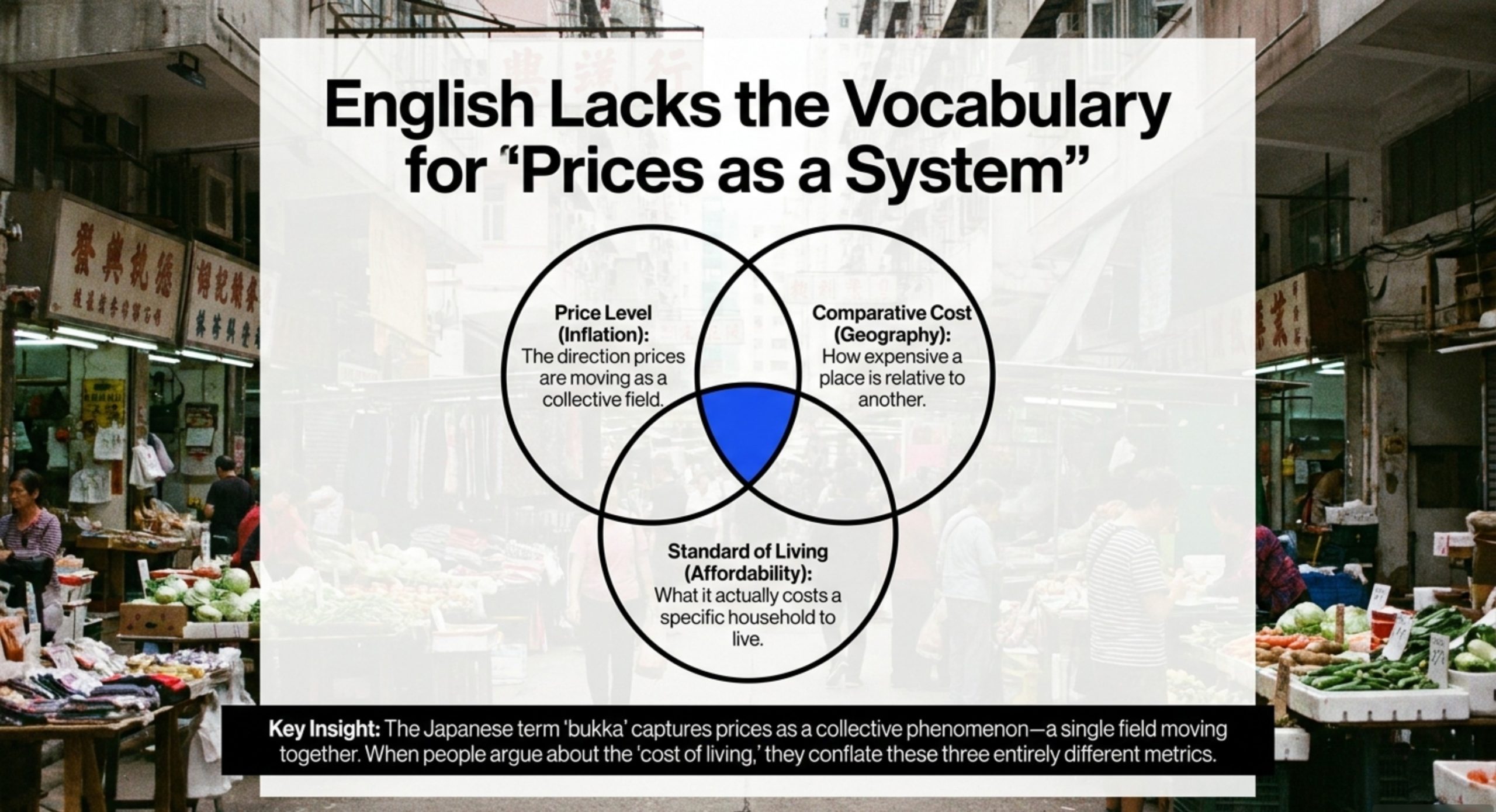
In everyday use, “cost of living” carries three separate meanings, and each has a legitimate technical counterpart.
The first is the price level and its movement, which is what national statistical agencies measure through consumer price indices. This is the sense in which a country has “high inflation” or “low inflation.” It says how fast prices are changing, not how expensive the place is.
A second sense is the comparative price level between places: whether Zurich is more expensive than Lisbon, whether Tokyo is more expensive than Sydney. This is what cost-of-living indices and international comparison surveys attempt to capture. It says how expensive a place is relative to another at a single moment, and says nothing about the direction of travel. A country can be extremely expensive and have almost no inflation. Switzerland has spent years in exactly that position.
Third comes the household budget requirement: what it actually costs a given person or family to live in a given place at a given standard. This is the sense people mean when they ask what a family of four needs per month, or whether a particular salary is liveable in a particular city. It depends on the household as much as on the location, which is why every honest answer to such questions is a range rather than a figure.
These three are routinely mixed together in public discussion. A headline reporting that inflation has fallen describes the first meaning. A reader who concludes that their city has become cheaper has jumped to the second. A reader who concludes that their own budget will now stretch further has jumped to the third, and is very likely to be disappointed. Slower price increases still mean price increases.
Cost of Living Is Not Standard of Living
A further distinction, frequently blurred: the cost of living measures what a fixed standard of living costs, not how well people live. Standard of living is about what households actually consume and enjoy — housing quality, health, leisure, the range of goods available. Cost of living is about the price tag attached to a specified bundle.
The two can move in opposite directions and often do. A city that becomes more expensive because it has become more desirable, better connected, and more productive may offer a higher standard of living at a higher cost. A country where prices collapse because industry has collapsed offers a lower cost of living and a considerably worse standard of it. Cheapness is not a virtue in itself, and expensiveness is not automatically a failure. What matters is the relationship between what things cost and what people earn.
This is also why comparing cost-of-living indices across countries without comparing incomes produces nonsense conclusions. A country where a monthly basket costs a quarter of what it costs elsewhere is genuinely cheap for a visitor holding foreign currency and possibly not cheap at all for a resident earning local wages. The index is measuring prices, not affordability. Affordability requires the income side, and the two sides are usually reported by different institutions using different methods.
Why “Cost of Living” Sometimes Means Something Else Entirely
The phrase has acquired institutional meanings that are narrower still. A cost-of-living adjustment, in employment and pension contexts, is a contractual or statutory increase in a payment tied to a published price index. A cost-of-living payment, in several countries, refers to a specific one-off government transfer made in response to a price shock. A cost-of-living allowance, in expatriate compensation, is a supplement calculated from a survey of prices faced by relocated employees, which uses a deliberately unrepresentative basket weighted toward imported goods and international schooling.
These are all reasonable uses of the words, but they measure incompatible things. An expatriate cost-of-living survey and a national consumer price index will rank the same set of cities differently, because they are pricing different lives. The expatriate survey asks what it costs a foreign professional to maintain a home-country lifestyle abroad. The national index asks what it costs the average resident household to maintain its own existing consumption pattern. Neither is wrong.
There is one further ambiguity worth clearing, particularly for readers moving between English and Japanese sources. In Japanese construction and engineering, 物価本 or 物価版 refers to a periodical publication of standard unit prices for materials and labour, used in cost estimation for public works. It is a price book, not a price index, and it serves procurement rather than economic analysis. Someone searching for information about 建設物価 is looking for construction cost references, not for consumer inflation data. The overlap in vocabulary is a coincidence of translation, but it sends a steady stream of people to the wrong material.
The Coffee and the Rent
A concrete case makes the layering visible. Imagine two households in the same country, one in a large capital city and one in a small provincial town. Both buy the same coffee at roughly the same price, because coffee is traded internationally and retail margins are similar. Both pay wildly different rents, because land is not traded internationally and cannot be moved.
Now suppose national inflation runs at three per cent for a year. In the provincial town, where housing is roughly a fifth of the household budget and rents are flat, the household experiences something close to three per cent. In the capital, where housing is nearly forty per cent of the budget and rents rose seven per cent, the household experiences something closer to five. Both households live under the same headline number and neither of them actually faces it.
This gap between the published rate and the lived rate is the single most common source of the complaint that official statistics are wrong. They usually are not wrong. They are averages, and no household is average. A retired couple who own their home outright, spend heavily on energy and medical care, and buy few electronics will experience a completely different effective inflation rate from a young renter who spends on transport, dining, and technology. Both are correctly described by the national index and neither is described well.
The way out of this is not to distrust the numbers but to know what they aggregate. Statistical agencies publish component detail precisely so that anyone can reconstruct a personal inflation rate from their own spending pattern. Doing so takes about twenty minutes and permanently changes how the headline reads.
What Rising Prices Actually Do to Money — The Price Level Explained
One consequence of the price-level-as-money’s-value framing deserves stating early, because it shapes so much of what follows. A rising price level does not only make future purchases more expensive. It reduces the real value of money already held and of every claim denominated in fixed money terms.
Cash under a mattress loses purchasing power at exactly the rate of inflation. A bank deposit paying less than the inflation rate loses purchasing power at the difference. A fixed pension not linked to any index loses purchasing power year after year in a way the recipient can feel but not see, because the number on the statement never changes. This is why indexation — the practice of tying payments to a published price index — exists at all, and why the design of those indices becomes politically consequential.
It also runs in the other direction. A fixed-rate debt becomes lighter in real terms as prices rise, because the borrower repays in currency worth less than the currency borrowed. Inflation quietly transfers value from lenders to borrowers, from savers to debtors, and from people whose incomes are fixed to people whose incomes adjust. That redistribution is not incidental to inflation. It is one of its central effects, and it explains why the political response to a price surge is never merely technical.
A Note on the Word “High”
People describe prices as high in two incompatible ways, and the ambiguity causes real confusion in policy debate. A price can be high in level terms — a litre of milk costs more here than there — or high in rate terms, meaning it is rising quickly. A country can have the highest price level in its region and the lowest inflation rate in its region simultaneously, which is roughly the Swiss position and has been for a long time.
The confusion becomes expensive when it reaches policy. Central banks target the rate, not the level. When a central bank announces success in bringing inflation back to target, it is saying that prices have stopped rising quickly. It is not saying that prices have returned to where they were, and no central bank in a modern economy is trying to engineer that. The accumulated increase stays in the level permanently unless something unusual and generally unwelcome happens.
This is why the public mood and the official data can diverge so sharply in the year or two after a price surge. Statistically, the episode is over. Experientially, it is not, because the household is comparing today’s prices with the ones it remembers from before the surge, while the statistics compare today with twelve months ago. Both comparisons are valid. They simply have different baselines, and the household’s baseline is the one that governs how people feel about their finances.
With the vocabulary settled, the next question is procedural. If the price level is a construction rather than an observation, somebody has to construct it — and the choices made in that construction determine what the resulting number can honestly be used for.
What the Full Version Covers — and Why the Foundation Here Matters
This post is drawn from the introduction and opening chapter of a larger work on the cost of living. The foundation laid here — what the phrase means, why the measurements diverge, why inflation and high prices are different problems — is the lens through which every subsequent question becomes answerable.
The full version goes considerably further. It covers how price indices are actually constructed, what the different types capture and where each one misleads. It traces a century of price history across the major economies and examines the recent surge with contribution analysis rather than headline watching. It works through how the burden of rising prices falls differently across households by income, age, and tenure, and addresses what governments have actually tried, with the evidence on what works and what quietly makes things worse.
The closing section looks at where prices go from here — not with forecasts pretending to certainty, but with the structural forces and markers that a price-literate reader can track for themselves.

コメント