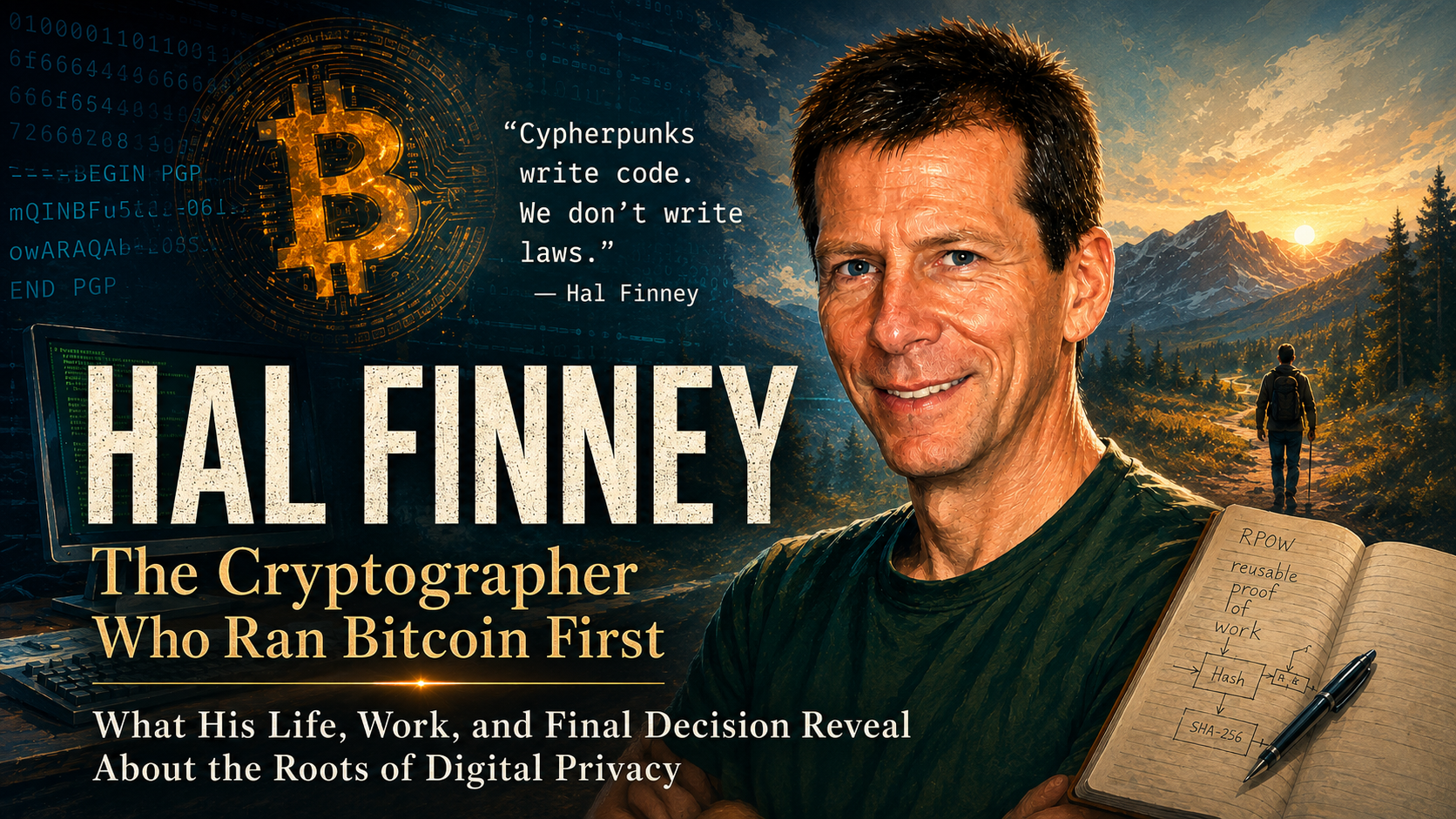
In January 2009, a software engineer in his early fifties opened a new program on his home computer, ran it, and posted two words to an internet discussion list that had spent weeks debating whether the software had any chance of working. The message was “Running bitcoin.” Most of the people who read it did not respond. Seventeen years later, those two words are among the most cited in the history of technology, and the man who wrote them is recognized across the world under a name that, in his own lifetime, few people outside specialist circles ever knew.
That man was Hal Finney. He was a software engineer who spent the better part of two decades helping to build the cryptographic foundations that now underlie digital privacy for hundreds of millions of people. He was the first person outside the system’s anonymous creator to run Bitcoin as a working node. He became, in the final years of his life, the subject of some of the most debated questions in the history of digital finance. And he faced the illness that killed him with a composure that those who followed the story found harder to explain than the technical achievements. This article opens with what the record actually shows about who he was.
The excerpt below is drawn from a full-length biography that traces his life from a small Central Valley oil town through the early wars over encryption, to the morning he first ran a piece of software that would eventually upend the global understanding of money. The opening chapters, reproduced here, cover the question of identity: who Hal Finney was before the legend attached itself to him, and what in his background made that legend, however incomplete, understandable.
Who Was Hal Finney: The Quiet Center of the Bitcoin Story
The name Hal Finney is most commonly encountered in two contexts: as the man who received the first Bitcoin transaction and as the strongest candidate for the identity of Satoshi Nakamoto, Bitcoin’s anonymous creator. Both framings are accurate as far as they go, and both miss something. Understanding what they miss requires starting earlier, with the shape of the man before the events that made him famous.
Introduction: The Quiet Center of a Loud Revolution
Most people who type his name into a search bar arrive with a single sharp question, and the question is rarely the same twice. Some want to know how he died. Some have heard he was the real inventor of Bitcoin and want the matter settled. Others have stumbled onto the strangest detail of all, that his body now rests in a steel vessel of liquid nitrogen in the Arizona desert, and they want to know whether that is true and what it could possibly mean.
Hal Finney sits at the meeting point of all those questions, and the curious thing is that no single answer satisfies any of them. He was the first person other than Bitcoin’s pseudonymous creator to run the software. He received the first Bitcoin transaction ever sent. He wrote a price estimate in early 2009 so audacious that it still circulates as either prophecy or folly. He spent his last years typing with his eyes because a motor neuron disease had taken everything else. Each fact is true, and each one, taken alone, distorts him.
This book exists because the scattered version of Hal Finney does him a disservice. Search results give you a man assembled from trivia, a frozen head here, a famous tweet there, a marathon alibi somewhere else. The real person was more coherent than that mosaic suggests. A single thread runs from the boy in a California oil town to the cryptographer breaking export-grade ciphers, to the dying programmer who still found joy in a clean piece of code. The thread is a conviction that technology should return power to the individual, and that the way to prove a principle is to build something that works.
The reward for reading on is that the pieces stop being trivia and start being a life. You will understand why a man who helped lay the foundations of digital cash insisted he was not its author, and why the people closest to the question still argue about it. You will see why his prediction of a ten-million-dollar coin was a thought experiment rather than a forecast, and why that distinction matters. You will learn what cryopreservation actually involves, and why his decision to undergo it was the most consistent act of his life rather than the most eccentric.
A note on what this book is not. It offers no guidance on buying or selling anything, names no asset worth owning, and promises no returns. Finney himself cared far more about the design of a monetary system than its price on any given day, and the chapters that follow keep faith with that priority. What you will find instead is a portrait drawn from the verifiable record, with the legends labeled as legends and the gaps left honestly open.
The story begins not with Bitcoin but with a question of character, because the cryptography came later and the temperament came first.
A Life Assembled From Three Identities
Pinning down Hal Finney in a sentence is harder than it looks, and the difficulty is the point. He was a gifted programmer, yet calling him a programmer misses the half of him that thought constantly about freedom, power, and the social meaning of the tools he built. He spent years writing entertainment software for a toy company, then years more at the frontier of encryption, and finally he became the earliest hands-on participant in an experiment that would reshape how millions of people think about money. The breadth is the first thing to understand about him, because it explains why no single label sticks.
People who knew his work tended to describe him through whichever facet they had encountered. To the cypherpunks of the early internet he was a tireless contributor who actually shipped code while others theorized. To the privacy industry he was the dependable engineer who made strong encryption usable by ordinary people. To the first Bitcoin enthusiasts he was the elder statesman who had seen digital cash fail before and recognized, faster than almost anyone, that this attempt was different. These were not three different men. They were three views of a person whose interests refused to stay in one lane.
Why his biography is the prehistory of cryptocurrency
Between the late twentieth century and the early twenty-first, computing and cryptography migrated out of military and academic enclosures and into the hands of ordinary citizens. Encryption that once protected state secrets became a feature anyone could download. The ability to communicate without revealing who was talking to whom, long the province of intelligence agencies, turned into a public utility built by volunteers. And the idea of moving value without a bank or a government in the middle went from a fringe speculation to a working system.
Finney had a hand in nearly every stage of that migration. He worked on the software that let individuals encrypt their messages against corporate and state surveillance. He ran the relays that let people speak anonymously. He designed an early mechanism for issuing scarce digital tokens, and then he became one of the first to test the system that finally solved the problems his own design had only approached. These look like separate inventions, but they are knots on one rope, and the rope is the project of shifting control from institutions to individuals.
That is why following his life so closely resembles following the origin story of modern cryptocurrency. He was not a bystander who happened to be present at the creation. He was a craftsman who had been working the same material for two decades when the decisive breakthrough arrived, which is precisely why he could grasp its significance while it still looked, to most observers, like a toy.
The engineer, the thinker, the neighbor
The first identity is the technical one. He earned a degree in electrical engineering, wrote code for the earliest home game consoles, and later took charge of cryptographic software that had to be both mathematically sound and genuinely usable. His gift was translation, the rare ability to turn an abstract protocol into something that actually ran on a real machine without breaking.
The second identity is the reflective one. Finney did not love technology only as technique. He asked what it meant, who it served, and what kind of society it would produce. What is privacy worth, and to whom. What is freedom in a networked world. Who, in the end, should own the right to issue money. His writings on these questions still read as clear-eyed rather than dated, because he reasoned from principles rather than headlines.
The third identity is the most easily forgotten and the most important for understanding him. He was a husband and father who loved long-distance running, who faced a terminal illness with unusual composure, and who kept finding satisfaction in programming long after his body had failed. Strip away this human texture and the story curdles into legend, the cypherpunk saint frozen in nitrogen. Keep it, and you have a person whose choices, including the strangest ones, make sense.
How to read this book
The chapters move roughly in the order his life did, from a small town through school, a first career, an intellectual conversion, a body of cryptographic work, the arrival of Bitcoin, the riddle of Satoshi, illness, death, and what came after. The sequence matters, because each phase grew out of the one before it. A curiosity sparked in one decade became a profession in the next and a historic contribution in the one after that.
Read with the causal links in mind and a single arc emerges rather than a heap of anecdotes. The boy who optimized code to fit inside a game cartridge becomes the engineer who could implement a cipher correctly under pressure. The volunteer who ran an anonymous remailer becomes the man who understood, immediately, why a peer-to-peer ledger changed everything. Hold the thread, and even the final chapter, the one about liquid nitrogen and a twenty-year wager on future medicine, reads as a conclusion rather than a curiosity.
A reputation built on shipping rather than talking
The early cryptography community had no shortage of brilliant talkers. Mailing lists filled nightly with manifestos, schemes for untraceable money, and arguments about the political future that strong encryption would supposedly guarantee. What set Finney apart was a habit that sounds mundane and was in fact rare: he finished things. When a protocol needed an implementation, he wrote it. When a cipher needed testing, he tested it and reported what broke. When a colleague floated an idea that could be built, he was often the one who built a working version while the debate continued around him.
This reliability gave his judgments unusual weight. A person who has actually shipped a remailer, debugged a key exchange, and shepherded encryption software through real-world use speaks about feasibility with an authority that pure theorists cannot match. So when Finney looked at a new design and said it would work, or warned that it would not, people listened in a way they did not listen to louder voices. His credibility was earned in the only currency engineers fully respect, which is running code.
It also shaped how he argued. He disliked grand claims unsupported by demonstration, and he had a gentle, almost teacherly way of redirecting hype toward the practical question of whether a thing could be made to function. That instinct would matter enormously when an unknown developer posted a nine-page description of an electronic cash system to a cryptography list, and most readers shrugged. Finney did not shrug. He had spent twenty years learning to tell the difference between a clever essay and a buildable system, and he could see which one he was looking at.
Why the legends cluster around a quiet man
There is an irony at the heart of his fame. Finney was modest, soft-spoken, and allergic to self-promotion, yet he has become the subject of some of the most dramatic legends in the history of technology. The myths gather around him for reasons that have little to do with his temperament and everything to do with his position.
He was close enough to the creation of Bitcoin that many concluded he must have been its secret author. He made a numerical claim about the currency’s possible value so large that it could only be remembered as either genius or madness. He chose, on the strength of a lifelong conviction, a form of preservation after death that most people associate with science fiction rather than with a careful engineer’s risk assessment. Proximity to a mystery, a startling number, and a body in liquid nitrogen are exactly the raw materials from which legends are made, and he supplied all three without ever seeking the attention they generated.
The aim of the chapters ahead is not to puncture these stories for the sake of it, but to set each one back inside the life that produced it. The Satoshi question, examined honestly, becomes more interesting than the rumor, not less. The ten-million-dollar figure, read in context, reveals a mind doing something more careful than guessing. The decision about his body, traced to its roots, turns out to be the least surprising thing he ever did. A quiet man can cast a long shadow, and the work here is to measure the shadow against the man who threw it.
What we can actually know about him
A biography of a private engineer faces an obvious problem: the subject left no memoir, gave few interviews, and spent most of his life in the unglamorous middle distance of technical work. Yet the record is richer than that sounds, because Finney belonged to a generation that thought in public on the early internet. His reasoning survives in thousands of mailing-list messages, forum posts, and code commits, written in a plain, careful voice that is unmistakably his.
That archive is the backbone of any honest portrait. We have his own account of how he discovered cryptography and why it gripped him. We have the design notes for the systems he built, which show how his mind moved from problem to mechanism. We have his earliest public reactions to Bitcoin, posted in real time, before anyone knew whether the experiment would survive a month. And we have the long, composed message he wrote near the end, when typing meant tracking a cursor with his eyes, in which he summed up his life with a candor he rarely showed elsewhere.
Around that primary material sits a second layer of evidence: the testimony of the people who worked beside him, the obituaries written by those who understood his contribution, and the forensic analyses that later tried to settle the questions his proximity to Bitcoin raised. This outer layer must be handled with more caution, because memory drifts and admirers exaggerate. Where the record is firm, this book states things plainly. Where it is thin or contested, it says so rather than papering over the gap with invented detail.
The method matters because so much of what circulates about him is embellishment. Precise figures for his coin holdings, confident claims about wallet addresses, dramatic readings of his silence, all of these tend to outrun the evidence. A trustworthy account has to be willing to say the words that legends never include, which are simply that we do not know. Holding to that discipline costs a few thrilling certainties and buys something better, a man you can actually believe in.
The cost of the scattered portrait
There is a practical reason to insist on coherence rather than collage. When a life is remembered only as a set of striking fragments, the fragments start to compete, and the loudest one wins. For Finney, the loudest fragment is usually the frozen body, followed closely by the Satoshi rumor, and between them they have nearly swallowed the rest of him. A reader could be forgiven for thinking the interesting thing about him was how he ended rather than what he did.
That inversion is worth correcting, because his actual contributions were substantial and his actual character was admirable, and both get flattened when the trivia takes over. The encryption work that protected millions of conversations, the early and clear-eyed reading of a new monetary design, the steadiness in the face of a merciless disease, these are not footnotes to a curiosity about cryonics. They are the substance, and the curiosity is the footnote.
Restoring that order is the organizing aim of everything that follows. Each striking fragment will get its chapter and its honest treatment, but always inside the sequence that produced it, so that by the end the reader holds a person rather than a pile of facts. The portrait only works if it is built in order, which means starting where he started.
It starts in the Central Valley of California, in a town built on oil, where a boy was raised to believe that the world was a problem and problems were meant to be solved.
Hal Finney Family, Origins, and the Coalinga Years
No biography of Hal Finney spends much time on Coalinga, the small Central Valley city where he was born and raised, because he himself rarely discussed it. But the chapters below show why that omission is a mistake. The environment of his boyhood, the rationalist temperament it encouraged, the family he came from and the family he built, all of these shaped his response to the larger events that would later define his reputation.
Coalinga: The Making of a Rationalist
Harold Thomas Finney II entered the world on the fourth of May, 1956, in Coalinga, a small city set among the farms and oilfields of California’s Central Valley. The town’s name itself records its reason for existing: it began as a coaling station, a place where the railroad stopped to refuel, before petroleum became the wealth beneath its soil. To grow up there in the postwar years was to grow up inside an industry of extraction, where engineers studied invisible underground structures and coaxed value out of rock.
His father, also named Harold Thomas Finney, worked as a petroleum engineer, and the profession is worth pausing on because it leaves fingerprints on a child’s imagination. Drilling for oil is an exercise in reasoning about what cannot be seen. You assemble fragments of geology, physics, and chemistry into a model of the formations far below, and you stake real money on whether the model is right. The work rewards a particular cast of mind, patient, quantitative, willing to trust a chain of inference over a gut feeling. His mother, Virginia, kept the household in which that sensibility was the water the family swam in.
A childhood inside the age of science
The America of the late 1950s and early 1960s was gripped by a confidence in technology that is difficult to recapture now. The space race lent the whole culture a forward tilt. Children were handed the vocabulary of rockets, reactors, and computers as though these were the furniture of the near future, and a boy in a technical household absorbed that optimism early. Science was not a school subject so much as a promise about what the world was becoming.
Finney took to mathematics and the sciences with the ease of someone who had found his native tongue. More telling than any particular aptitude was the stance he developed toward difficulty itself. Faced with a hard problem, he did not treat it as a mystery to be revered or a fate to be accepted. He treated it as a structure to be taken apart, formalized, and solved. That reflex, the decomposition of the baffling into the tractable, would define every chapter of his working life.
It is tempting to read too much into a childhood, but one continuity is hard to ignore. The grown man who would later approach his own death as a technical problem rather than a metaphysical one was visibly the same person as the boy who learned, in an oil town, that the unseen could be modeled and the intractable could be engineered. His worldview held that reality was knowable, improvable, and open to intervention. The universe was not a riddle to be endured but a system to be understood and, where possible, repaired.
A worldview grounded in reason rather than faith
Any account of his outlook has to tread carefully on the question of belief, because the honest answer is that he left no record of belonging to a particular religious tradition. To assign him a denomination would be to invent a fact. What his words and choices do reveal is a thoroughly secular temperament, one that placed its trust in observation, logic, and experiment rather than in revelation.
This was not a hostile or polemical atheism so much as a quiet displacement of where hope was directed. Where a religious sensibility might locate the answer to mortality in an afterlife, Finney located it in the possible future achievements of science and medicine. He did not expect deliverance from above. He wagered, instead, on the long upward trend of human knowledge, betting that problems unsolved in his lifetime might yield to the tools of a later one.
That stance is best understood not as despair dressed up but as a distinct species of optimism. He chose hope over resignation, but his hope rested on something he considered observable, the demonstrable record of technological progress, rather than on faith in the unseen. Grasping this is essential for making sense of the book’s final chapters, because the decision that strikes outsiders as his most bizarre flows directly from this early and consistent orientation. The man who later entrusted his body to a future that did not yet exist was simply applying, at the limit, the worldview he had carried since childhood.
The family he would build
The rationalist temperament did not make him cold, and nothing in his life refutes the caricature of the unfeeling engineer more thoroughly than the household he eventually created. In adulthood he married a woman named Fran, and together they raised two children, a son and a daughter, whom he described in his own later writing as technically capable young people he trusted completely. The pride in those words is unmistakable, and so is the tenderness.
His family occupied the center of his concerns in a way that the public legend, fixated on cryptography and frozen tissue, tends to crowd out. As his illness advanced and his independence eroded, the subject he returned to was not his technical legacy but the people he would leave behind and what he could secure for them. When he wrote about the practical matter of passing on what he owned, the tone was a father’s, weighing how to protect his children’s future, not a theorist’s musing about digital scarcity.
There is a revealing detail in how he framed the safekeeping of his most valuable property. He noted, plainly, that it sat in a safe deposit box and that his son and daughter understood technology well enough to manage it. The new instrument of value he had helped pioneer was, in his own household, not an abstraction at all but an ordinary parental concern, an inheritance to be handed down with care. The history of invention is usually told as heroic adventure, yet at the center of his story sits this modest, domestic gaze, the look of a man thinking about his kids.
Leaving the valley
A boy raised among derricks and irrigation canals eventually understood that his own curiosity pointed away from what lay underground and toward what could be computed. In the America of the era, a gifted and science-minded young person who reached that realization had a recognizable next step, the pursuit of a place at an elite technical university. Finney’s talents and inclinations pointed him in exactly that direction.
The destination he set his sights on was one of the most demanding scientific institutions in the country, a campus on the West Coast where the density of brilliance was almost a physical fact. The move from the quiet streets of Coalinga to that intellectual pressure cooker was more than a change of address. It was the journey of a young person searching for an intellectual home, a place where his way of thinking would be the norm rather than the exception.
An American boyhood, and the question of origins
Readers who go looking for Finney’s background often want to fix his origins precisely, to know his ancestry, his ethnicity, his roots. The verifiable answer is straightforward and a little undramatic. He was an American, born and raised in California, the son of a working professional family in a mid-century western town. He belonged to the broad postwar middle class that produced so many of the engineers and scientists who would later build the digital world, and his story is in that sense a thoroughly American one.
Beyond those plain facts, speculation about lineage adds nothing reliable and risks inventing detail where none is documented. What shaped him demonstrably was not any particular heritage but an environment, the specific blend of technical work, scientific optimism, and rural self-reliance that defined the Central Valley of his youth. Coalinga gave him a front-row view of applied science in the oilfields and a small-town childhood far from the centers of cultural fashion, a combination that tends to produce people who value substance over show.
It is worth resisting the pull toward a more exotic origin story, because the ordinariness is itself instructive. The man who would later stand at the center of a financial revolution did not emerge from privilege or from some rarefied intellectual dynasty. He came from a place most maps skip, raised by parents who solved practical problems for a living, and he carried the unglamorous virtues of that upbringing into everything he touched.
The shape of a temperament
By the time he reached the threshold of adulthood, the essential elements of his character were already visible. He was analytical without being cold, drawn to hard problems for the pleasure of solving them rather than for any prize they might bring. He was modest in manner, more comfortable demonstrating a thing than declaring it. And he carried an unusual evenness, a steadiness that would later astonish the people who watched him face catastrophe without bitterness.
That steadiness deserves emphasis, because it is the trait that connects the boy to the man across every later chapter. The same composure that let him reason calmly through a stubborn engineering problem would, decades on, let him reason calmly about his own dying. He approached both with the conviction that panic clarifies nothing and that the right response to a frightening situation is to understand it as exactly as possible.
There was also, beneath the analytical surface, a streak of genuine playfulness. He enjoyed games, puzzles, and the small delight of making a machine do something clever, and that delight never left him. The man who would later call an astonishing financial projection an amusing exercise was, in this respect, perfectly continuous with the boy who found problems fun. Seriousness and play were not opposites in him but partners, and the partnership was the engine of his creativity.
None of these traits would have predicted fame. They were the makings of a fine engineer and a decent man, nothing more spectacular than that, and for most of his life that is exactly how he was regarded by those around him. The spectacular part came later and from outside, attached to events he could not have foreseen. The person underneath remained the steady, curious, faintly playful figure who had taken shape in a small California town.
These were the raw materials, a rational mind, a steady heart, and a taste for difficulty pursued as pleasure, that he carried out of the Central Valley and toward the most demanding classroom in the American West.
Born at the right hour
Timing is rarely chosen and often decisive, and Finney’s birth year placed him with uncanny precision at the dawn of personal computing. A child of 1956 reached the threshold of higher education at the exact moment when computers were shrinking from room-sized machines tended by specialists into devices a single person could own and command. He would come of age, professionally, just as the tools he was suited to master were becoming available to individuals for the first time.
Members of that narrow cohort enjoyed an advantage that is easy to underrate. They were young enough to treat the microcomputer as native territory rather than as a disruption to unlearn, and old enough to have been trained in the rigorous fundamentals that the hobbyist wave often lacked. They could write tight, disciplined code because they had learned computing when every cycle and every byte was precious, and they could imagine what the new cheap machines might become because they had grown up expecting technology to advance.
Finney fit that profile almost too neatly. His rigorous schooling would give him the fundamentals, and his temperament would give him the curiosity to push past them. The accident of when he was born meant that the skills he was naturally inclined to develop would arrive in the world exactly when they were most needed and least common. None of this was planned, of course, and he would have been the last person to claim credit for the calendar. But the historian of his life has to notice that the man and the moment were unusually well matched.
Why Hal Finney’s Biography Goes Beyond the Bitcoin Legend
The chapters above cover roughly the first quarter of Hal Finney’s story, from his birth in 1956 through the formative years that shaped his thinking long before cryptography became a public concern. What is striking, reading them, is how consistently the character they describe persists through everything that follows. The analytical calm, the preference for demonstration over declaration, the willingness to engage seriously with ideas that most of his contemporaries dismissed as eccentric: these were already present in the boy from Coalinga, and they are what makes the later chapters coherent rather than merely dramatic.
The complete biography traces the full arc: his entry into the cypherpunk movement of the early 1990s, his work on PGP and the encryption tools that brought him into the first serious conflict between governments and code, his invention of RPOW in 2004, and the morning in January 2009 when he ran the software that a person or group calling themselves Satoshi Nakamoto had released to the world. It covers the first Bitcoin transaction, the years of collaboration with an author he never met in person, and the diagnosis that arrived just as his most consequential technical contribution was beginning to be understood. It covers his death and his decision, made long before that death, about what should happen to his body. The full version goes through all of it, following the same method applied here: what the record actually shows, stated plainly, and what it does not show, stated with equal plainness.
Finney was not a man who sought to be remarkable. He was a man who took the problems in front of him seriously and worked on them with care. The legend that gathered around him afterward is partly a product of the extraordinary moment he happened to occupy and partly a reflection of something true: that the work he did was genuine, the thinking behind it was honest, and the life that contained both was coherent from beginning to end. Those qualities are not common, and they are worth understanding in detail.

コメント